

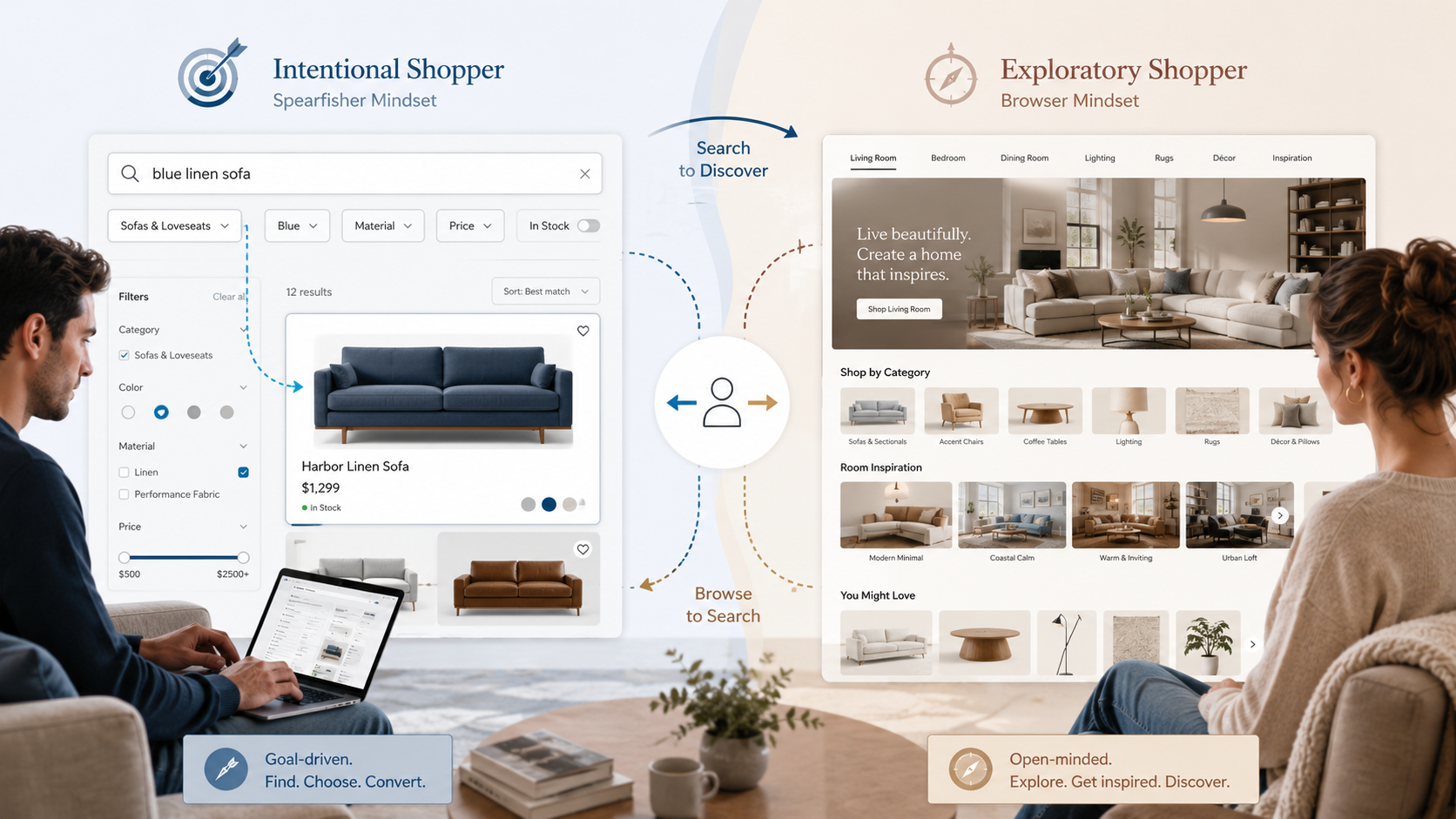
Most retailers have a website. Far fewer have stopped to define exactly what that website is supposed to accomplish for the business.
Store hours, locations, brands, promotions, featured products, financing, these are all expected. And while some retailers execute them with better design, stronger imagery, sharper messaging, or more effective calls to action, the underlying blueprint often looks remarkably similar. The bigger question is whether the site has been built around how shoppers actually behave. What percentage of your traffic arrives with a specific intent (the spearfisher below)? Where are paid campaigns landing those shoppers? How quickly can someone find the product, category, style, or information that brought them there? And once they find it, how effectively does the experience invite them to explore further?
If most visitors arrive looking to accomplish something specific, a site designed primarily around broad browsing may be spending valuable time and real estate solving the wrong problem. Before adding another promotion, navigation item, or merchandising feature, retailers should map the purpose of the visit, understand the funnel of activity, and make sure the experience captures that intent before the opportunity disappears.
When consumers visit a retail website, their behavior is highly fluid but statistically leans toward purpose and intention rather than wide exploration. [1]Data from Nosto and Google Cloud shows that between 69% and 78% of online shoppers go straight to the search bar when visiting an e-commerce site. This indicates that the vast majority of users land on a website with a specific task, product, or category in mind.
However, the reality of online shopping is not a strict "either/or" dynamic. It is a spectrum governed by product categories, device types, and shifting mental states. [1, 2]
🏹 The Intentional Shopper: "Spearfishers" Intentional shoppers treat the retail site as a utility to execute a specific mission. [1]
-
High-Intent Indicators: These users rely heavily on the internal search box, filters, and facets. They often search for specific attributes (e.g., "women's waterproof hiking boots size 7") or exact product names. [1, 2, 3]
-
Disproportionate Revenue: While intentional "searchers" typically account for only 15% to 30% of total site traffic, they generate an astronomical 40% to 45% of total site revenue. [1]
-
High Conversion: According to data published by Forrester Research, intentional searchers convert at 2x to 3x the rate of casual browsers. [1]
-
Low Patience: This group is highly fragile. If the internal search engine fails to find what they want on the first try, Lily AI reports that 80% of shoppers will abandon the site immediately. [1]
🛍️ The Exploratory Shopper: "Browsers" Exploratory shoppers use retail websites the way people traditionally used physical malls - for entertainment, digital window-shopping, or vague information gathering. [1]
-
Low-Intent Indicators: These users rely on category navigation menus, "New Arrivals" sections, homepage banners, and recommendation sliders. [1, 2]
-
The First-Visit Myth: Exploration dominates early-stage interactions. Industry data from Episerver reveals that only 17% of consumers visiting a brand's website for the first time have a primary intent to purchase. The rest are comparing prices, checking return policies, or just browsing. [1]
-
Discovery Commerce: On specialized or discount platforms, discovery is the point. For instance, data from the online grocery outlet Martie notes that 55% of their shoppers visit specifically to discover something new because deep discounts alleviate purchase hesitation. [1]
🔄 The Fluid Reality: Shopping Mode Transitions The most crucial insight for modern retail is that consumers constantly shift between exploration and intention during a single session. E-commerce user behavior studies published by the Association for Computing Machinery (ACM) show that: [1]
-
63% of exploratory browsers switch to a goal-directed search the moment an interesting item catches their eye.
-
80% of goal-directed shoppers switch over to exploratory browsing (looking at "frequently bought together" sections or sales) after they find their primary item. [1]
Your website should not simply present your business online. It should be designed around what your shoppers are trying to accomplish when they arrive. That means understanding where traffic comes from, what intent brought the shopper to the site, how quickly they can find what they came for, and what should happen next. Search, navigation, merchandising, content, recommendations, and calls to action should all support that journey. When you map those behaviors deliberately, the website becomes more than a digital storefront. It becomes a more effective path from intent to discovery, and from discovery to conversion.
Take a fresh look at your own website. Are you designing around how shoppers actually behave, or around the same retail website blueprint everyone else is following?
Blueport helps furniture retailers build digital experiences around shopper intent, product discovery, merchandising, and conversion. If you are ready to rethink how your website supports the customer journey, let’s talk.