

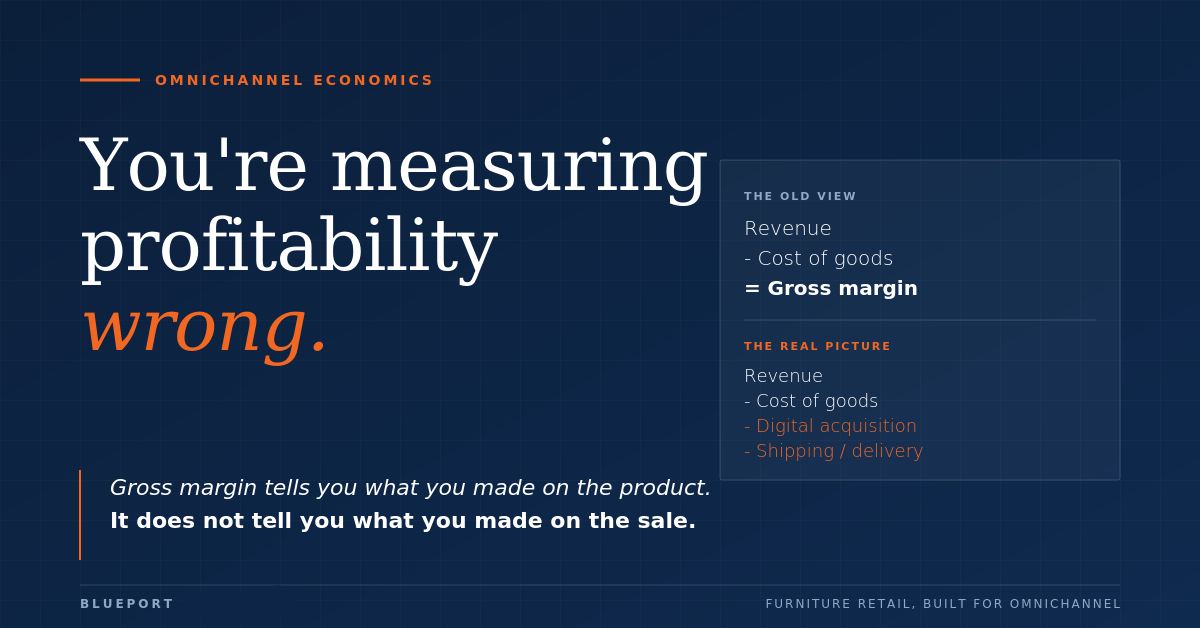
You're Measuring Profitability Wrong in an Omnichannel World
A simple question came up in a recent roundtable: How much should a retailer spend on digital advertising? It is a fair question. It is also the wrong place to start.
The better question:
What does it actually cost you to acquire and fulfill a sale today?
The Traditional View Still Dominates
Most retailers still evaluate performance the same way:
- Revenue
- Cost of goods
- Gross margin
That framework made sense when the store did most of the work. It breaks down in an environment where:
- customers begin online
- research happens across channels
- the final transaction can happen anywhere
What's Missing from the Equation
Every modern sale carries two realities that gross margin ignores:
- you paid something to acquire the customer
- you absorbed some portion of shipping or delivery
Neither shows up in gross margin. That is correct from an accounting standpoint:
- cost of goods includes product, inbound freight, and direct costs
- advertising is treated as operating expense
- shipping is buried in logistics
This follows accepted accounting rules. It does not reflect how the business actually performs.
Why This Matters
You can report a healthy gross margin while losing money on every digitally influenced order. That is the disconnect. Retailers are making decisions without seeing:
- customer acquisition cost
- fulfillment cost per order
Both directly impact profitability.
A Better Way to Look at It
Do not change your accounting. Change how you manage. Introduce a simple management view:
Adjusted Contribution per Sale
- Gross revenue
- minus cost of goods
- minus digital marketing spend
- minus shipping or delivery cost
This is not a GAAP metric. It is a decision-making tool. It answers a simple question:
Was this sale actually worth it?
But Do Not Apply This Blindly
This is where traditional retailers can go wrong. They take pure ecommerce math and apply it to a retail model.
That creates bad decisions.
Not Every Sale Carries the Same Acquisition Cost
Pure ecommerce assumes every order has a CAC. Your traditional retail business does not work that way.
You have:
- stores with walk-in traffic
- repeat customers
- brand recognition in your market
Many transactions:
- start in-store
- are influenced by a sales associate
- close online later
Apply full digital acquisition cost to every order and you will:
- undervalue store influence
- misread channel performance
- distort profitability
A better approach:
- evaluate CAC as a percent of digitally influenced revenue
- separate new customer acquisition from existing demand
Your Website Is Not Just an Acquisition Channel
For most furniture retailers, the website is:
- a research tool
- a validation layer
- a closing mechanism
Not every online order is ecommerce driven.
Some are:
- store-driven, completed online
- associate-influenced, finalized later
- convenience-based, not discovery-based
That distinction matters.
Shipping Is Not Always a Margin Loss
In pure ecommerce, shipping is a cost retailers look to minimize. In local furniture retail, delivery often enables the sale. You are not only competing on price. You are competing on:
- convenience
- speed
- trust
Delivery can remove friction and close the transaction. That changes how you evaluate it.
Not Every Product Should Be Pushed Digitally
Layer in acquisition cost and shipping cost and the difference between products becomes clear.
A lower-ticket item:
- has limited room for paid acquisition
- is more sensitive to delivery cost
A higher-ticket item:
- can absorb CAC
- can support a richer experience
- benefits more from omnichannel engagement
This is not about reducing digital investment. It is about applying it where it works.
Where Retailers Are Getting Tripped Up
Most are flying blind because:
- marketing is buried in blended budgets
- shipping is hidden inside operations
- costs are not tied back to individual sales
This masks the true impact of omnichannel commerce on your margin.
What the Data Typically Shows
As a starting point:
- digital marketing often runs 6% to 20% of revenue
- shipping continues to rise as a percentage of sales
- free shipping expectations limit recovery
Individually, these seem manageable. Combined, they can erode profitability quickly.
The Real Shift
You are no longer just selling products.
You are:
- acquiring demand
- guiding a cross-channel journey
- fulfilling the final transaction
Each step carries cost. Each step influences margin.
The Model That Wins
This is not about becoming a pure ecommerce company.
That model depends on:
- national scale
- optimized logistics
- high-volume acquisition efficiency
Most furniture retailers have a different advantage:
- local presence
- physical showrooms
- inventory proximity
- human interaction
The winning model is local, omnichannel commerce.
Where:
- the website drives discovery
- the store builds confidence
- the customer completes the purchase wherever it is easiest
How to Use This Going Forward
Do not overcomplicate it.
Start with visibility:
- track digital marketing as a percent of revenue
- understand average shipping cost per order
- evaluate both against ticket size and conversion
Then ask:
- which sales required paid acquisition
- which were store influenced
- which products support digital investment
- where delivery helps or hurts conversion
The Takeaway
Gross margin tells you what you made on the product. It does not tell you what you made on the sale. Ignore the cost to acquire and the cost to deliver and you miss where margin is gained or lost. Apply pure ecommerce math to a retail model and you risk making the wrong decisions.
The answer sits in the middle. Measure both. Operate where your model is strongest.
You are not trying to become a pure ecommerce company.
You are building a business where online and in-store work together to drive profitable growth.
Over the next few weeks, I will go deeper on the sections above.
Expect focused posts on:
- how to actually build the Adjusted Contribution per Sale view
- why store-influenced sales break pure ecommerce math
- when shipping works as a sales tool, not just a cost line
- which products deserve digital investment, and which do not
Retail on,