

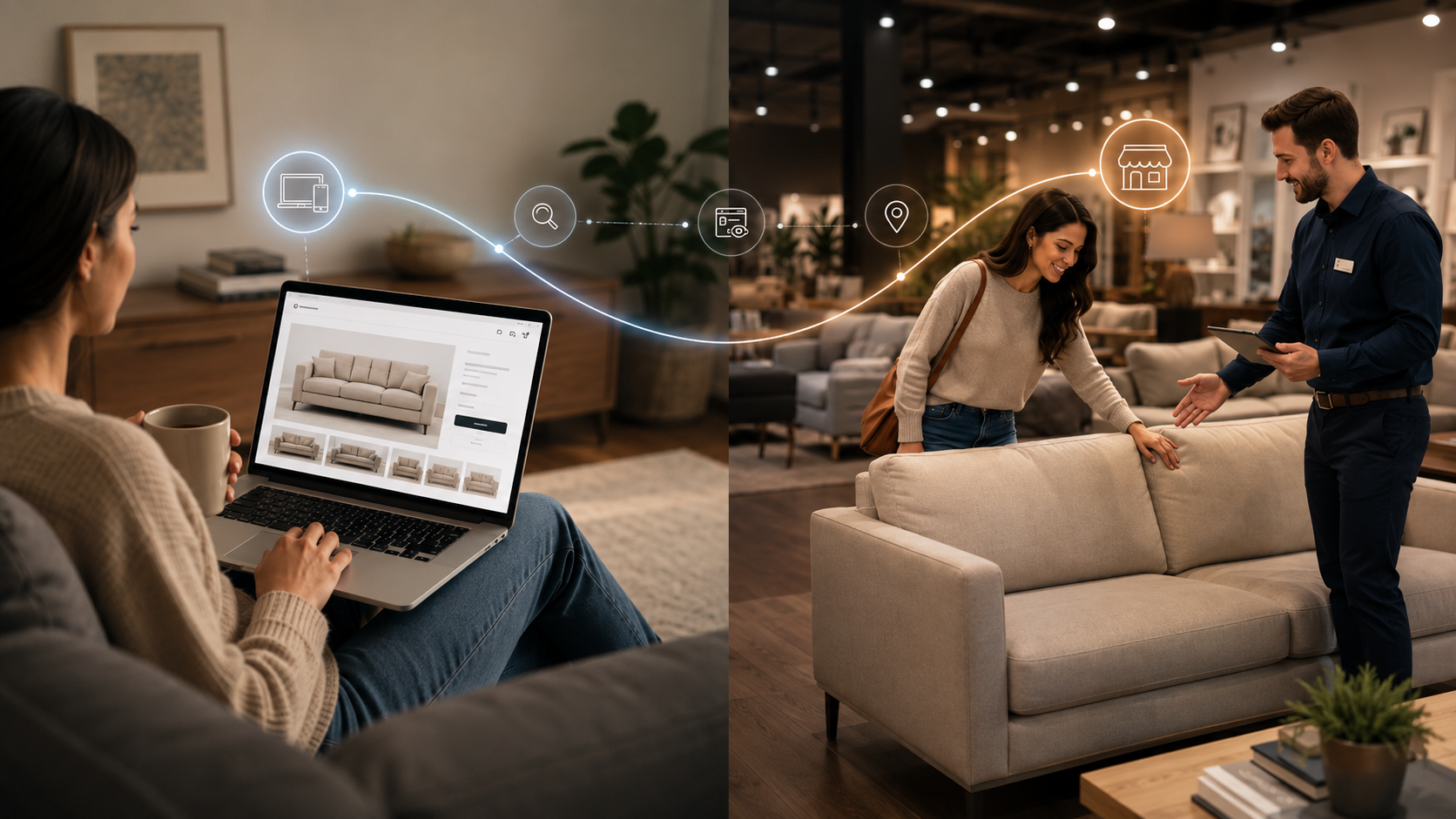
Why Store-Influenced Sales Break Pure Ecommerce Math
A few weeks ago, I wrote about how gross margin no longer tells you what you made on a sale.
This is a deeper look at one piece of that problem. The piece most retailers underestimate.
Store influence.
The Setup Most Retailers Are Running
Walk into most traditional furniture retailers and you will find two businesses operating under one roof.
The store team:
- measured on store revenue
- compensated on store-written tickets
- focused on the customer in front of them
The ecommerce team:
- measured on online conversion
- compensated on web revenue
- focused on the order that closes online
Two teams.
Two scorecards.
One customer.
That is where the math breaks.
The Online-as-Amazon Trap
Most furniture retailers treat their website like a national ecommerce site. Sell whatever, ship wherever, optimize for conversion.
The store keeps doing what it has always done.
The two are not designed to work together.
They are designed to operate next to each other. That worked when the website was a small slice of the business.
It does not work now. The customer journey has changed.
Your model has not caught up.
What Store Influence Actually Looks Like
A customer walks into your store on a Saturday.
-
They sit on three sofas.
-
They take photos.
-
They leave without buying.
Two weeks later, they buy that sofa on your website.
Question: which channel made the sale?
Pure ecommerce math says the website did.
It will assign:
- the digital acquisition cost
- the shipping cost
- the full credit
Reality says the store did most of the work.
The website just made it easy to finish.
Now reverse the example.
A customer browses your site for two weeks.
They read reviews.
They configure a sectional.
They drive 40 minutes to your store to see it in person.
A salesperson closes the sale.
Pure store math gives the salesperson full credit.
The website that pulled the customer in gets nothing.
Both examples are the same problem.
The math does not see the full picture.
Why Pure Ecommerce Math Fails Here
Pure ecommerce companies do not have this issue.
They have:
- one channel
- one acquisition path
- one place the sale closes
Every order can be measured cleanly.
CAC, AOV, contribution margin, all calculated per order.
Your business does not work that way.
You have:
- walk-in traffic the website did not generate
- web traffic the store made possible
- repeat customers driven by brand presence
- sales that started in one channel and closed in another
Apply pure ecommerce math to that mix and you get distorted answers:
- digital looks more expensive than it is
- the store looks more productive than it is
- both look worse than they really are when measured against each other
You start making bad decisions based on bad numbers.
The Cost of Competing Models
When online and offline operate as separate businesses, the damage shows up in four places.
Misallocated digital spend.
You measure CAC against online revenue only.
The website looks unprofitable.
You cut digital investment.
Store traffic drops three months later.
You never connect the two.
Sales staff that fear the website.
If the store team is paid only on store-written tickets, the website becomes a threat.
Customers ask about online prices. Staff push back.
Customers want to use online financing. Staff resist.
The friction shows up in the sale.
Inconsistent pricing, inventory, and promotion.
The web team runs one promotion.
The store runs another.
The customer sees both.
Trust drops.
A fractured customer experience.
The customer does not care which team owns which channel.
They expect:
- the same price
- the same product availability
- the same answers
- continuity between visits
When they do not get it, they question the brand.
Sometimes they leave.
What the Customer Actually Experiences
Put yourself in the shopper's seat.
You find a sofa online.
You go to the store to see it.
The store does not have it on the floor.
The salesperson has never heard of it.
The price tag on a similar model is $200 higher than the website.
There is no record of what you looked at online.
You start over from scratch.
You leave.
That is not a technology problem.
That is an operating model problem.
The store and the website are not the same business to the customer.
They expect them to be.
What a Unified Model Looks Like
This is not about merging teams.
It is about aligning how they measure, operate, and serve the customer.
A unified model treats the website and the store as one business with two surfaces.
The website is:
- the digital front door
- the catalog the salesperson uses on the floor
- the place the customer researches before visiting
- the place the customer finishes the purchase if they choose to
The store is:
- the showroom that builds confidence
- the place the customer touches the product
- the relationship layer pure ecommerce cannot match
- a closing channel for web-initiated journeys
Same products. Same prices. Same promotions. Same customer record.
Same brand.
What You Can Do Now
You do not need a platform overhaul to start.
Begin with visibility and alignment.
See the full journey.
Track which sales touched both channels.
Most retailers are surprised how high that number is.
For furniture, it is often the majority of high-ticket transactions.
Stop measuring channels against each other.
Measure the customer journey end to end.
Web-assisted store sales count.
Store-assisted web sales count.
Both channels should get credit for influencing the outcome.
Align compensation with reality.
If a sales associate helped a customer who later bought online, recognize it.
If you do not, your team will fight the website forever.
Align pricing, inventory, and promotion.
The customer sees one brand.
Make sure they get one experience.
Use technology that supports the model.
A website that does not connect to your store systems will keep the silos in place.
An Point-of-Sale -integrated platform with shared inventory, shared pricing, and shared customer data is the foundation.
Without it, you are running two businesses no matter what the org chart says.
The Real Question
Your customer is not asking whether their purchase belongs to ecommerce or to retail.
They are asking whether you make it easy to buy from you.
If your model treats online and offline as separate businesses, you make it harder.
If you align them, you make it easier.
That difference shows up in conversion.
It shows up in basket size.
It shows up in repeat purchase.
It shows up in margin.
The Takeaway
Pure ecommerce math punishes the channel that did not close the sale.
In furniture retail, that math punishes the wrong channel often.
The store influenced more online sales than you think.
The website influenced more store sales than you think.
Measure them in isolation and you will keep making the wrong calls.
Measure them together and the picture sharpens.
This is exactly what Blueport built OneView to solve.
OneView connects the shopper's journey across devices, the website, and the store point-of-sale.
It tracks every touch point that influenced the sale.
It credits the salesperson who helped, even when the order closes online.
When the math rewards the full team instead of pitting channels against each other, the silos start to break down.
The website stops being a threat to the store.
The store stops being a blind spot to the digital team.
The customer feels one brand, not two competing businesses.
One Line to Anchor It
Your customer is not shopping a channel.
They are shopping a brand.
Build a model, and use the technology, that reflects that.