

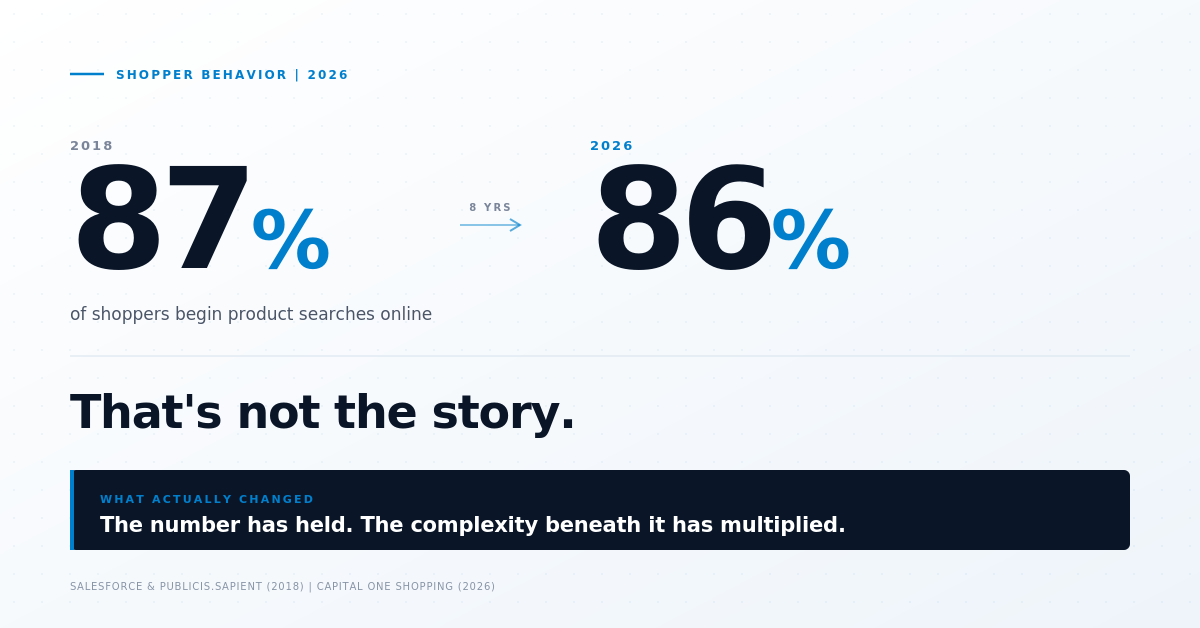
87% Then. 86% Now. That's Not the Story.
In 2018, a study made the rounds:
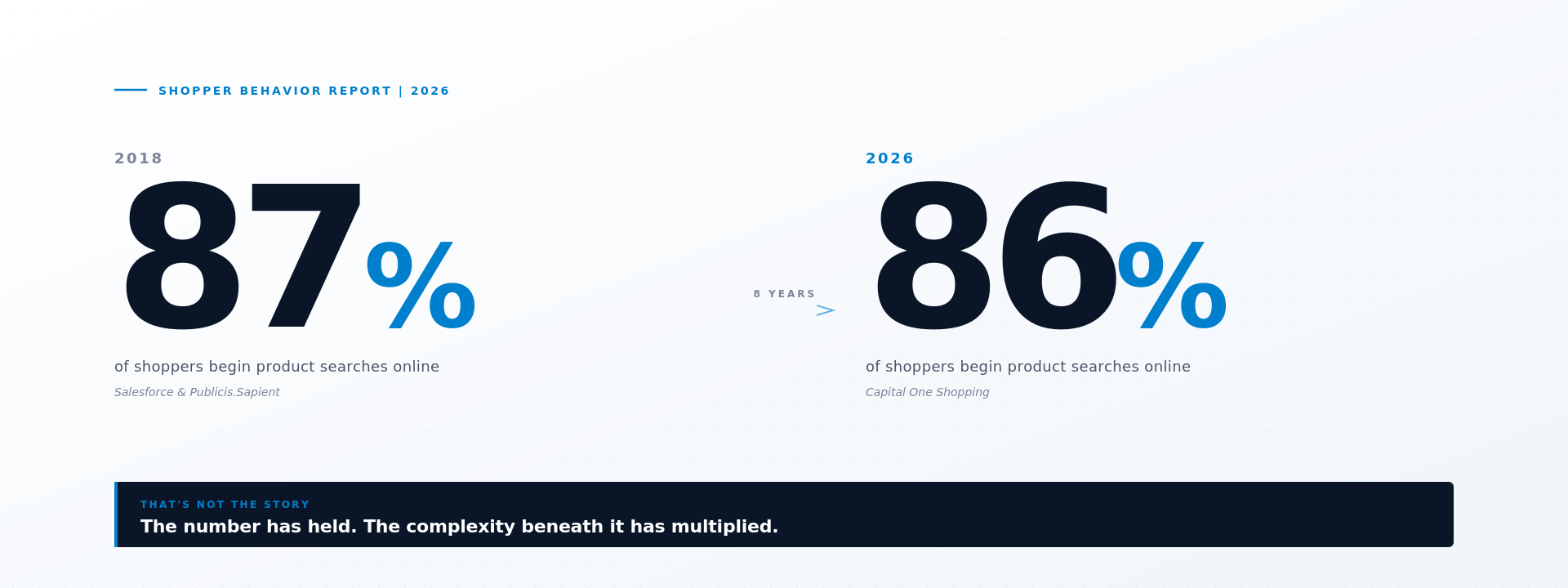
87% of shoppers now begin product searches online.
Eight years later, that number has barely moved. The 2026 data puts it at 86%.
Same headline. Completely different world underneath.
If you are a furniture retailer, the 86% is not the number to focus on.
The numbers below it are.
The Original 2018 Study
The 2018 Salesforce and Publicis.Sapient "Shopper-First Retailing" report found that 87% of shoppers begin product searches on digital channels, up from 71% the year prior.
At the time, that was a warning shot for traditional retail.
Retailers who thought the store was where discovery happened realized discovery had moved to the phone in the shopper's hand.
Website budgets followed.
2026: The Headline Is Almost Identical
Fast forward eight years. Three separate 2026 reports tell the same story:
-
Capital One Shopping (June 2026): 86% of shoppers start product research online, even if they buy in-store
-
Consumer Gravity (March 2026): 81% of customers research online before making a purchase
-
SellersCommerce (April 2026): 83% of people do their research online before visiting in-store
The number has held.
If you stopped reading here, you might feel comfortable staying the course you set in 2018.
That would be a mistake.
What Has Actually Changed
Underneath the 86% headline, three shifts have transformed what the number actually means.
1. The Starting Point Has Fragmented
In 2018, "starting online" mostly meant a Google search or a brand's website.
That has fractured:
-
44% now start on a search engine
-
41% start directly on an online store like Amazon or a retailer's website
-
14% start on social media
-
60% report using ChatGPT, Gemini, or another AI assistant somewhere in their product research
Where the shopper enters your world is no longer predictable.
Search, marketplace, social feed, AI chat. Each has different rules and a different playbook.
Your store's website is now competing against Amazon, TikTok, and ChatGPT for the same attention.
2. The Website Is Now Part of the Store Visit
This is the stat that matters most for furniture retail.
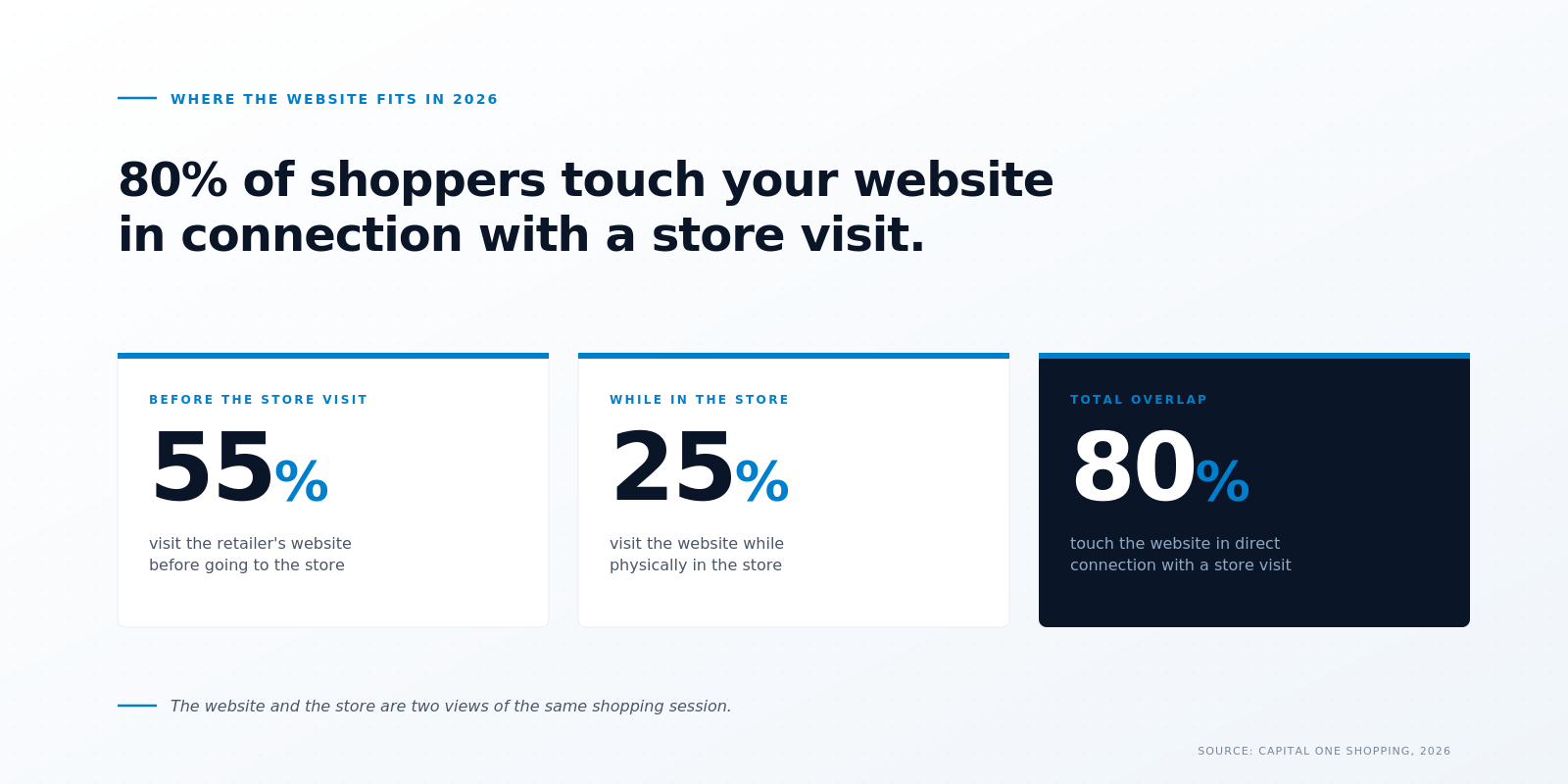
Per Capital One Shopping's 2026 data:
-
55% of shoppers visit a retailer's website before going to a physical store
-
25% visit the website while shopping in-store
Combined, that is 80% of your shoppers touching your website in direct connection with a store visit.
Not before. Not after. During.
The website and the store are no longer separate touchpoints. They are two views of the same shopping session.
If your website does not know what happened in the store, or your store does not know what happened on the website, the shopper feels the gap.
3. Mobile in the Store Is the New Normal
Related, but worth its own line:
-
77% of online shoppers use their mobile devices for product research, often while browsing inside a physical store
-
59% use their phone or tablet in-store to compare products and prices
Your shoppers are on your website while they are in your store.
If the experience on those two screens does not match, they feel it.
The Furniture Angle Specifically
Home goods buyers behave differently than general retail. Two 2026 stats stand out:
-
40% of home goods shoppers are hybrid, moving between online and in-store within the same purchase decision
-
24% of consumers prefer to purchase furnishings and appliances online
Hybrid is not a niche behavior in furniture. It is the majority behavior.
This is not a customer who "starts online" and "buys in-store." This is a customer who moves between channels continuously, expecting the experience to move with them.
The AI Wildcard
The most important shift since 2018 is one that did not exist in 2018.
Per Salehoo's May 2026 report:
-
60% of US shoppers report using ChatGPT, Gemini, or another AI assistant in their product research
-
AI platforms are projected to drive $20.57 billion in US retail eCommerce sales in 2026
-
That is nearly 4x the 2025 figure
Shoppers are increasingly asking an AI to recommend furniture, not typing into Google.
If your catalog, product data, and specifications are not readable by AI agents, you are invisible in this new discovery channel.
This is why Blueport is building Agentic Commerce Optimization. It is early, and the trajectory is clear.
What This Means for Your Operation
The 86% headline tells you nothing you did not already know.
The numbers below it tell you what to do:
- Your website and store need to work as one connected experience
- Your mobile site needs to hold up when the customer is standing in your showroom
- Your product catalog needs to be readable by AI agents, not just Google
- Your team needs credit and visibility across every touch point
None of this is optional if you want the 86% to translate into actual revenue.
The Takeaway
Eight years ago, the 87% stat was a warning to build a website.
Today, the 86% stat is a warning to make sure your website, store, mobile experience, and AI catalog visibility work as one operation.
The number has held. The complexity beneath it has multiplied.
One Line to Anchor It
The shopper starts online. The shopper does not stay there.
The retailers who win are the ones whose systems move with the shopper.
Retail on,