Most furniture retailers I talk with have a marketing agency they trust. Many of those agencies also built the website, host it, and manage it.
On paper, that sounds efficient. One partner, one invoice, one team that knows your brand.
In practice, it puts the team that drives your traffic in charge of the site that has to convert it. The problems stay hidden until a busy weekend exposes them.
This is not a case against agencies. A good agency earns its fee. The question is what they build on.
What a good agency gets right
✓ They know your brand, your voice, and your customer.
✓ Your campaigns and your site stay aligned, so the offer in the email matches the landing page.
✓ One team moves fast when a promotion changes overnight.
✓ Creative, content, and SEO come from people who already know your business.
None of that is the problem. The problem sits underneath it.
Nine problems with one house
When one agency owns both your marketing and your website, here is what to watch for.
01
They grade their own work
- The agency builds the site, runs the campaigns, and writes the report.
- When conversion drops, nobody outside the agency can tell whether the ads or the site caused it.
- Some agencies rate your site with a score they created. Google Lighthouse is free, and anyone can run it.
Ask yourself: who tells you your website is the problem when the website belongs to the agency?
02
Their incentives favor campaigns over the site
- Retainers and media management pay better than maintenance.
- Page speed fixes, checkout bugs, and catalog cleanup sit in the queue while new landing pages ship.
03
Every campaign adds weight to the site
- Each campaign brings another tracking pixel, popup, chat widget, or retargeting tag.
- Third-party scripts are among the biggest drags on Google Lighthouse Performance and layout stability.
- Nobody says no to the next tag when the tag request and the site sit with the same team.
04
Agencies build sites as projects, but a furniture site has to be run every day
- An agency launches the site and moves on to the next client.
- A furniture site needs operational work every day:
- AI powered vendor catalogs that keep products, content, and options current
- Geo targeted content, so shoppers see the stores, delivery, and offers for where they live
- Delivery zones and store inventory
- A connection to your POS, so orders, inventory, and in-store quotes move between channels
- Carts and checkouts built for furniture
Ask yourself: can your checkout apply a storewide sale, a bundle offer, and a financing promotion to the same order?
05
A furniture agency on a general platform
- Some agencies work only with furniture retailers. That knowledge is real.
- The platform underneath was still built for general retail. Furniture features arrive as apps and custom code.
- Every app adds a monthly fee, a script on your pages, and another vendor to manage.
Ask yourself: what do you pay the platform and its app vendors on top of the agency fee?
06
Lock-in
- The agency often holds the hosting, theme code, admin logins, and sometimes the domain.
- Leaving the agency can mean rebuilding the website.
- Those switching costs weaken your position at every renewal.
Ask yourself: who owns the store account, the theme, and your catalog data on day one?
07
Every change goes through the agency
- Your team can't edit a banner or a product page without filing a request.
- Small fixes wait days.
- Whether it arrives as a ticket or a monthly plan, you pay someone else to change your own site.
08
One person holds the knowledge
- Often a single developer at the agency knows how your site works.
- When that person leaves, the knowledge leaves with them.
09
Unclear accountability
- Ask who answers when the site goes down on Black Friday.
- Ask who fixes it when an accessibility complaint arrives.
- The answer is often "we'll look into it" plus a quote.
What if your agency worked on a proven platform?
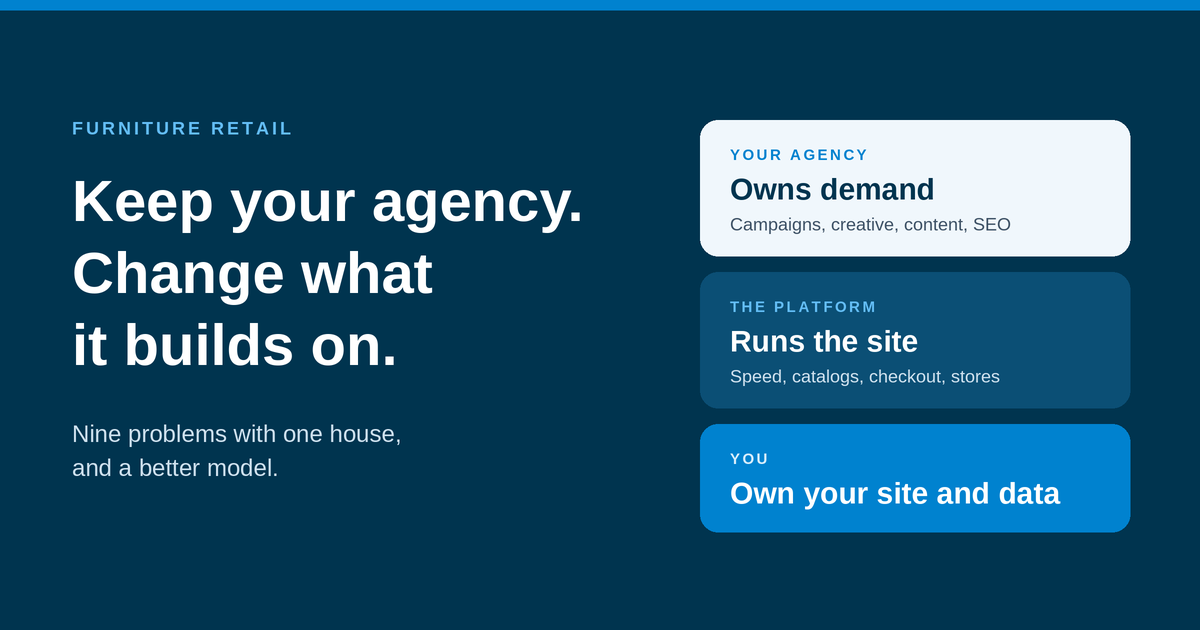
Keep the agency. Change what it builds on.
YOUR AGENCY
Owns demand
✓ Landing pages and campaign content
✓ Creative and brand
✓ SEO and promotions
THE PLATFORM
Runs the site
✓ Hosting, speed, and uptime
✓ AI powered vendor catalogs
✓ Carts and checkouts built for furniture
✓ The connection between your website and your stores
YOU
Own your site, your data, and your logins
- Your agency builds on the site without owning it.
- You keep your site, your data, and your logins.
- Performance gets measured on its own terms, apart from campaign results.
That is how the Essentials platform from Blueport works with agencies. Your agency gets access to build pages, content, and campaigns. Blueport runs the platform underneath and keeps releasing furniture features. Core furniture features are built into the platform, not added through apps. Blueport Essentials updates are included, so they never show up as a ticket.
Ask yourself: what would your agency deliver if it stopped spending your budget patching the site?
Three questions before your next agency review
If you fired your agency tomorrow, would you still have a working website?
When did your agency last recommend removing something from your site?
Who on your team can change your homepage today without a ticket?
Bring your agency to the conversation
We'll walk you both through how Blueport Essentials works with the team you already trust.